



















Multi-Asset Investments Views: You spin me round
KEY POINTS
The re-escalation of Middle East hostilities has effectively buried the Memorandum of Understanding between the US and Iran.
While markets enjoyed a strong rally following April’s recovery, broad equity indices have been struggling to advance since the beginning of June.
Investors’ positioning is elevated overall, with systematic strategies more heavily exposed, whilst discretionary investors are close to neutral and have therefore potential to increase holdings.
Global risk appetite is having to contend with a second-quarter earnings season that has started impressively on the one hand, and rising oil prices on the other, pushing central banks to be increasingly hawkish and driving real yields up.
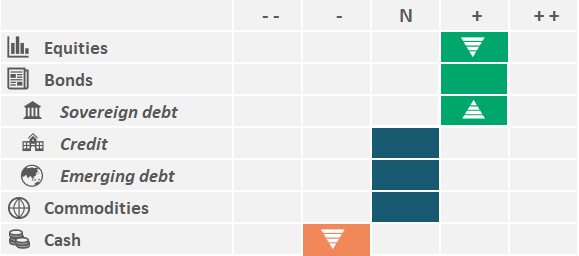
Broadly positive on shares
We remain positive on equities but have marginally reduced our allocation. The background has even improved lately - macroeconomic surprises in the eurozone turning net positive, a so far stellar reporting season, and a positive bias to analysts’ revisions.
Nonetheless, our proprietary quantitative signal for US equities has fallen sharply, brought down by monetary policy uncertainty and some early signs of credit risk, the latter albeit focused on the weakest part of the market.
Therefore, our qualitative expectations have been effectively tempered by our quantitative inputs, and we have chosen to take profits on a portion of the equity allocation.
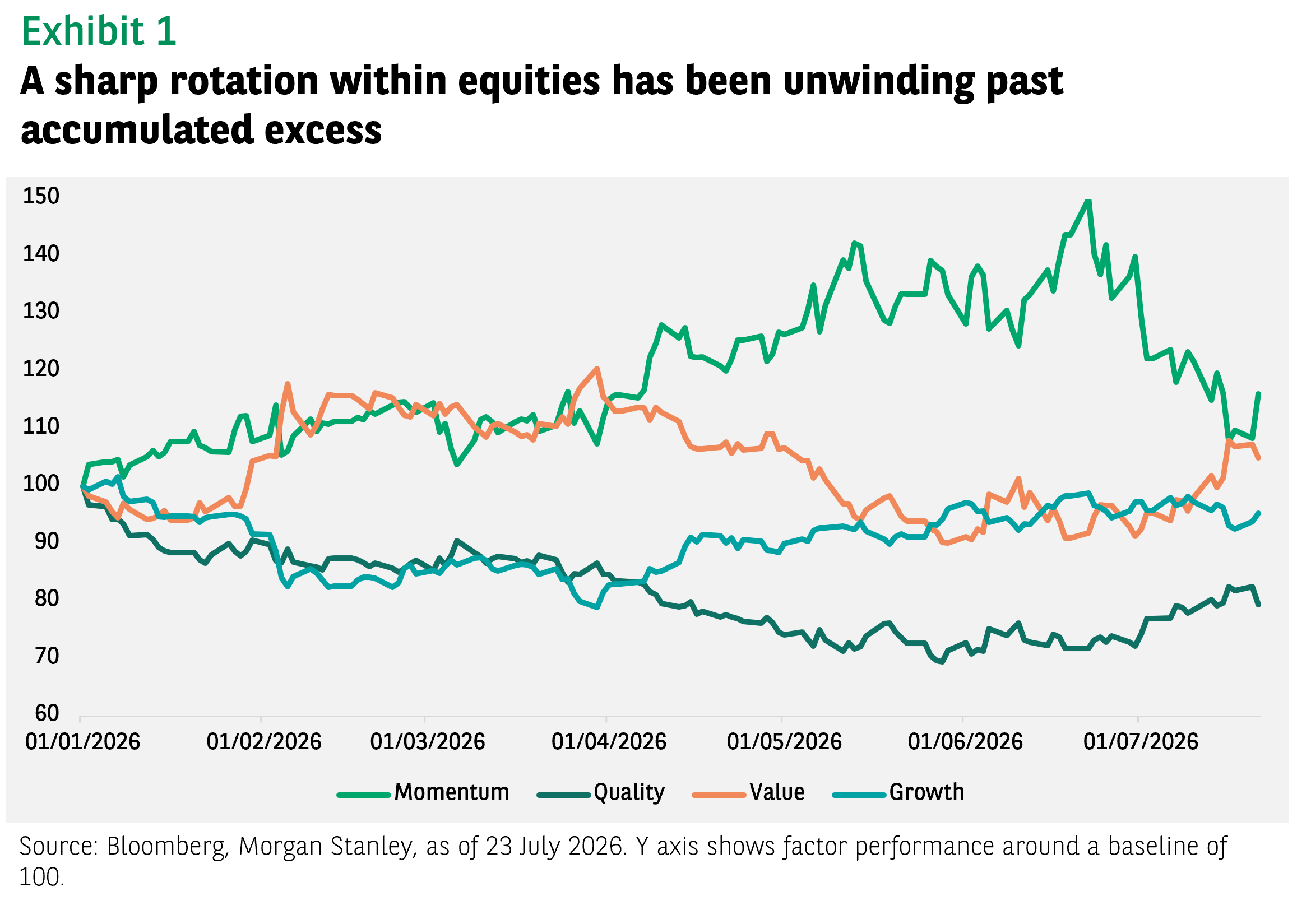
Furthermore, equity markets experienced a second rough rotation in as many months, with momentum giving back a significant portion of its outperformance from the previous quarter (see Exhibit 1).
Concomitantly, single-stock volatility has increased exponentially, and while broad index volatility (e.g. the VIX index) remains contained, such moves do not necessarily suggest a more severe bout of risk aversion.
Similarly, the recent weakness in CCC credit seems more idiosyncratic and sector-specific and is likely to potentially offer better returns in the quarter ahead rather than expand across the broad equity market. We held our positions in US technology after the shake-out which, combined with earnings upside, has cheapened valuations.
We have also maintained our relative preference for US financials and eurozone banks where investors’ positioning is low and rising. We would expect equity markets to resist a hike or two, as currently priced by markets, while the macro and the microeconomic backdrop remain strong.
A series of interest rate hikes would however likely prove painful, especially with the equity risk premium already at relatively unattractive levels.
Fixed income: Wait and see
On the fixed income side, we are biding our time before taking advantage of higher yields in the eurozone, as we are fundamentally sceptical that the European Central Bank will be able, or even willing, to raise policy rates more than twice this year.
In the short run, we are more confident that we are approaching peak hawkishness from the US Federal Reserve and its new Chair Kevin Warsh. The Fed’s tone is certainly at its most aggressive since the pandemic following a series of (favourable) misses on inflation data compared to market expectations.
Following softer US inflation data for several months, including an outright decline in June, we chose to add US duration at the short end of the yield curve.
The most recent rise has been led by real yields rather than higher break-even inflation, hence any relief there would also be welcome for equity markets.
Elsewhere, Japan 10-year yields have lost some of their upward momentum lately as suggestions circle over creating tax breaks for local investors in Japanese government bonds, as well as diverting investment flows from the Government Pension Investment Fund to the domestic bond market.
Neither appear to be ultimately realistic and the friction between the Bank of Japan’s needs to raise policy rates and the government’s preference for a weak yen is set to persist.
In recent months, credit markets concerns have been largely anecdotal and focused on ‘what if’ scenarios for private credit redemptions.
These have often ignored the large inflows from investors, or impending stress from significant and price-insensitive issuance from new entrants to the credit markets that might challenge what are historically tight levels for spreads.
While some truth resides in both cases, evidence of stress was thin on the ground. We are focusing on any signs of contagion from the widening of spreads in CCC markets up the credit quality spectrum, to Bs and BBs.
The bifurcation of CCCs versus Bs and BBs is unusual and worrisome if it were to persist.
Disclaimer
This document is for informational purposes only and does not constitute investment research or financial analysis relating to transactions in financial instruments as per MIF Directive (2014/65/EU), nor does it constitute on the part of BNP PARIBAS ASSET MANAGEMENT Europe or its affiliated companies an offer to buy or sell any investments, products or services, and should not be considered as solicitation or investment, legal or tax advice, a recommendation for an investment strategy or a personalized recommendation to buy or sell securities.
Due to its simplification, this document is partial and opinions, estimates and forecasts herein are subjective and subject to change without notice. There is no guarantee forecasts made will come to pass. Data, figures, declarations, analysis, predictions and other information in this document is provided based on our state of knowledge at the time of creation of this document. Whilst every care is taken, no representation or warranty (including liability towards third parties), express or implied, is made as to the accuracy, reliability or completeness of the information contained herein. Reliance upon information in this material is at the sole discretion of the recipient. This material does not contain sufficient information to support an investment decision.
Issued in the UK by AXA Investment Managers UK Limited, which is authorised and regulated by the Financial Conduct Authority in the UK. Registered in England and Wales, No: 01431068. Registered Office: 22 Bishopsgate, London, EC2N 4BQ.
AXA IM and BNPP AM are progressively merging and streamlining our legal entities to create a unified structure
AXA Investment Managers joined BNP Paribas Group in July 2025. Following the merger of AXA Investment Managers Paris and BNP PARIBAS ASSET MANAGEMENT Europe and their respective holding companies on December 31, 2025, the combined company now operates under the BNP PARIBAS ASSET MANAGEMENT Europe name.