



















Take Two: US stocks hit another peak; ECB cautions on market vulnerability
What do you need to know?
US stocks notched up another set of record highs, driven by strong technology company performances and cautious optimism over a potential deal in the Middle East which would extend the ceasefire and reopen the Strait of Hormuz. The S&P 500, Dow Jones and Nasdaq indices all reached record levels last week while oil prices eased. Meanwhile, the US economy grew at an annualised 1.6% in the first quarter, according to an official second estimate. The figure was revised down from the 2% growth initially estimated but remained above Q4’s 0.5% expansion.
Around the world
The energy supply shock poses both upside risks to inflation and downside risks to economic growth according to the European Central Bank’s latest Financial Stability Review. It noted, however, that financial markets are adjusting to the stress and energy supply disruptions, and that eurozone banks have navigated recent uncertainty well. However, the ECB warned that market sentiment could deteriorate, as downside risks “appear underestimated”. Markets are expecting an interest rate hike at the next ECB meeting. Separately, in the World Economic Forum’s latest Chief Economists’ Outlook, 89% of those surveyed anticipate global growth will weaken over the next 12 months.
Figure in focus: 2032
Solar is projected to become the world’s single largest source of electricity by 2032, surpassing natural gas, oil and coal, according to a report from BloombergNEF. The shift is expected to occur due to massive overcapacity, technological advancement and falling prices. Its analysis also found the outlook for battery deployment has increased, with storage jumping 17-fold between 2025 and 2035. The report noted that global energy transition investment reached a record $2.3 trillion in 2025 but to achieve a net zero scenario, it will require $235 trillion by 2050.
Chart of the week
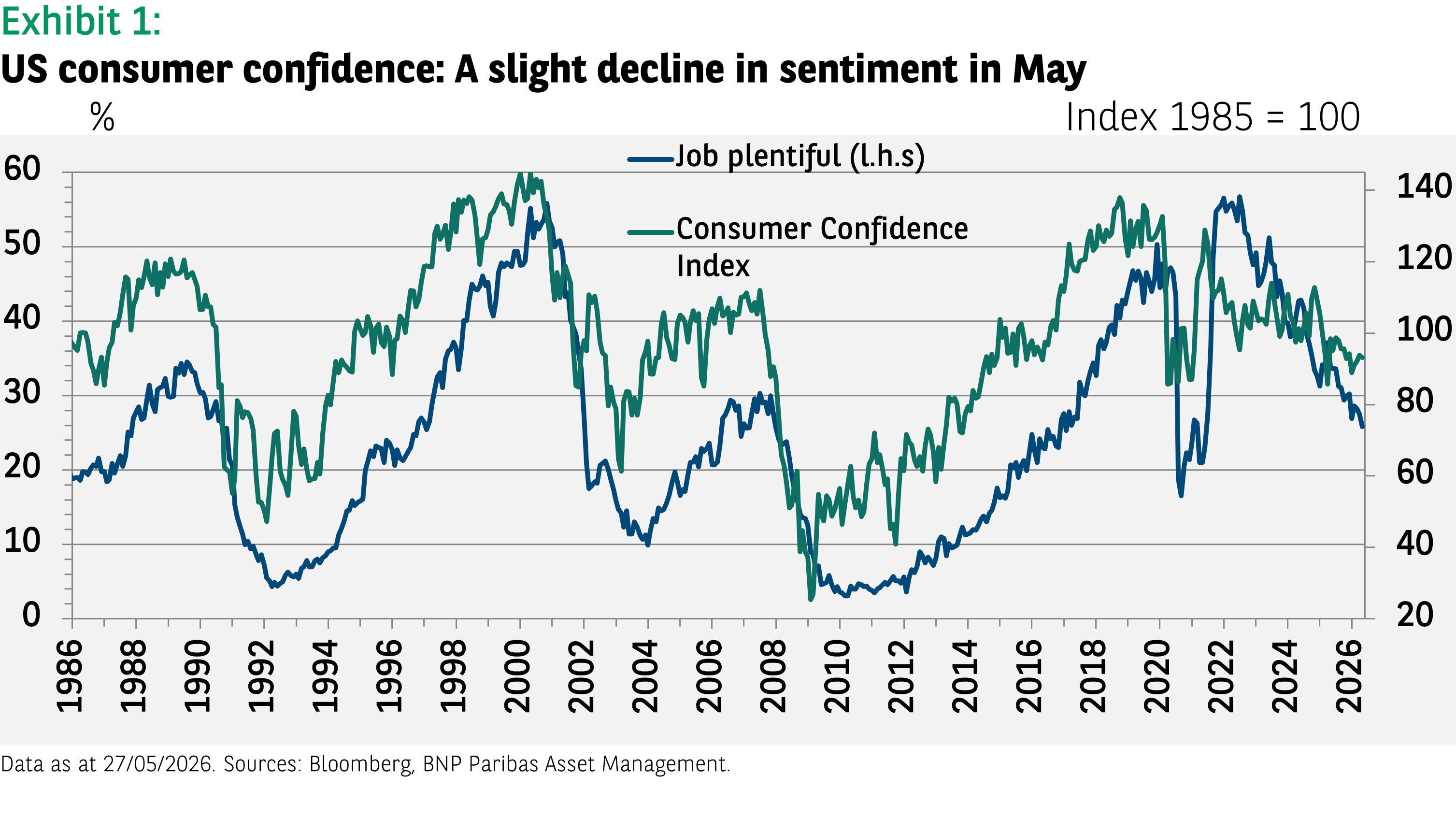
After Liberation Day US consumer confidence, as measured by the Conference Board, fell to a level not seen since 2020’s lockdown. Confidence has since risen but remains below its long-term average. However, real private consumption did not collapse. Studies show there is a correlation between consumer sentiment and consumer spending, but while statistically significant, it remains fragile. This relationship has become more tenuous since the 2021-2022 inflation surge and may explain why two-thirds of households said in May that they had reduced their spending in response to inflation. The other element to assess in the coming months is consumer attitudes to the labour market, as according to the Conference Board survey, just 25.5% of consumers said jobs are plentiful – the lowest since February 2021.
Words of wisdom
Catnomics: Cats’ economic influence on Japan is significant with the typical cat owner reportedly spending some ¥1.8 million (US$11,300) on their pets. A recent study from professor emeritus at Kansai University, Katsuhiro Miyamoto, on so-called ‘catnomics’ or ‘nekonomics’, showed that Japan’s adoration of its feline pets could add around ¥3 trillion (US$18.8 billion) to the Japanese economy in 2026. A report in The Guardian highlighted that the estimate was just shy of surpassing the economic impact of the 2025 World Exposition in Osaka, with Miyamoto noting that cats in Japan were delivering “a comparable economic effect, demonstrating the significant contribution cats are making to the Japanese economy”.
What’s coming up?
Monday sees the eurozone issue its latest unemployment rate and follow up with inflation data on Tuesday. Australia issues a Q1 GDP growth update on Wednesday when several composite Purchasing Managers’ Indices are also reported including those covering the US, UK, the eurozone, Japan and China. On Friday, the US updates markets with its latest job numbers and a third estimate for eurozone Q1 GDP growth is reported; the previous estimate showed the bloc’s economy expanded by 0.1% in Q1, a slight slowdown from Q4’s 0.2%.
Read more insights at the Investment Institute


Disclaimer
This document is for informational purposes only and does not constitute investment research or financial analysis relating to transactions in financial instruments as per MIF Directive (2014/65/EU), nor does it constitute on the part of BNP PARIBAS ASSET MANAGEMENT Europe or its affiliated companies an offer to buy or sell any investments, products or services, and should not be considered as solicitation or investment, legal or tax advice, a recommendation for an investment strategy or a personalized recommendation to buy or sell securities.
Due to its simplification, this document is partial and opinions, estimates and forecasts herein are subjective and subject to change without notice. There is no guarantee forecasts made will come to pass. Data, figures, declarations, analysis, predictions and other information in this document is provided based on our state of knowledge at the time of creation of this document. Whilst every care is taken, no representation or warranty (including liability towards third parties), express or implied, is made as to the accuracy, reliability or completeness of the information contained herein. Reliance upon information in this material is at the sole discretion of the recipient. This material does not contain sufficient information to support an investment decision.
Issued in the UK by AXA Investment Managers UK Limited, which is authorised and regulated by the Financial Conduct Authority in the UK. Registered in England and Wales, No: 01431068. Registered Office: 22 Bishopsgate, London, EC2N 4BQ.
AXA IM and BNPP AM are progressively merging and streamlining our legal entities to create a unified structure
AXA Investment Managers joined BNP Paribas Group in July 2025. Following the merger of AXA Investment Managers Paris and BNP PARIBAS ASSET MANAGEMENT Europe and their respective holding companies on December 31, 2025, the combined company now operates under the BNP PARIBAS ASSET MANAGEMENT Europe name.