



















Multi-asset investments views: Heartbreak express
KEY POINTS
Citadel’s acquisition of Situational Awareness's artificial intelligence-focused portfolio in late July was one of the likely catalysts for the summer’s AI and momentum market correction.
In our view, this combined with the deleveraging of crowded positions in Korean memory and AI-related semiconductor stocks, helped remove excess leverage and reset investor positioning.
The subsequent recovery in AI leaders is more consistent with a technical washout, rather than a structural deterioration in the theme. Against this backdrop, we modestly increased equity risk, with a concentration in US technology and semiconductor firms and Korean memory companies.
A key question surrounding the AI investment cycle is whether rapidly improving model efficiency and falling inference costs will ultimately undermine the economics of the ecosystem.
Recent data suggest the opposite may be occurring. The cost of tokens - the price users pay across major AI models - as measured by Silicon Data’s AI pricing index, has fallen by roughly 40% since the end of June, yet average AI spending per employee continues to grow robustly.
This points to a highly elastic demand profile, where lower costs stimulate consumption enough to increase overall spending. Importantly, the cost of intelligence decline has been accompanied by resilient demand for the underlying compute infrastructure.
Graphics processing unit rental prices have rebounded from their June lows, while hyperscalers’ cloud revenues continue to grow strongly, suggesting additional compute capacity is being rapidly absorbed by end-users.
In other words, efficiency gains are not reducing demand for AI hardware and infrastructure, they appear to be expanding the range and intensity of AI applications.
AI demand’s resilience has increasingly shifted investor attention away from the demand side of the equation and toward the financing requirements needed to sustain the buildout.
As hyperscalers accelerate investment in datacentres and compute capacity, bond investors have become more focused on the scale and funding of future capital expenditures. Investment grade tech spreads have widened, with hyperscaler credit spreads now back to levels last seen in 2022.
Watching long-term interest rates
Recent technology bond deals have seen weaker demand and underperformed in secondary trading, while market participants increasingly expect a significant increase in debt issuance to finance AI-related investments. Against this backdrop, developments in long-term interest rates are becoming increasingly important.
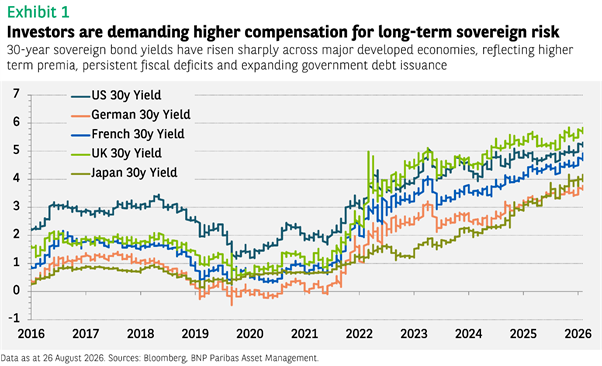
Treasury yields moved higher ahead of Jackson Hole, reflecting growing uncertainty around the interaction between the Federal Reserve's policy rate and longer-term market rates. While some have interpreted the steepening yield curve as a sign of diminishing confidence in the Fed, the evidence points instead to a rise in real yields rather than inflation expectations.
US inflation showed no meaningful signs of reacceleration, with July core CPI increasing just 0.2% month-on-month, reinforcing the view that policy rates are likely to remain unchanged in September.
At the same time, the labour market has shown increasing signs of cooling and broader activity indicators point to a gradual loss of economic momentum. Consistent with this assessment, July’s Federal Open Market Committee policy meeting minutes suggested members continue to view the current policy as sufficiently restrictive provided inflation keeps moderating.
Rising yields
Importantly, bond investors do not appear concerned about an inflation resurgence. Market-based inflation expectations remain relatively stable. Instead, investors appear to be demanding a higher term premium to compensate for increased uncertainty surrounding fiscal policy.
While US Treasury Secretary Scott Bessent has effectively tasked the Treasury to step into the market to control the yield curve, investors appear unconvinced that technical interventions in bond markets can substitute for meaningful action on spending and deficits.
Until greater fiscal discipline emerges, upward pressure on Treasury yields may persist, with implications for global asset allocation and valuation multiples across risk assets. Recent moves in the US dollar and gold market reinforce this narrative.
To be fair, the upward drift in long-dated sovereign yields should not be viewed exclusively through a US lens. Across developed markets, term premia are rising as investors reassess the implications of structurally higher fiscal deficits and sustained bond issuance.
The normalisation of Japanese monetary policy adds a further layer of pressure. As domestic yields move higher and the Bank of Japan continues its balance-sheet reduction, Japanese investors face less incentive to seek duration abroad.
For investors, the key implication is that financial conditions may continue to tighten through higher long-term yields, even without further Federal Reserve rate hikes. Elevated real rates remain a headwind for equity valuations, particularly in longer-duration segments of the market, while a sustained decline in Treasury yields will likely require greater confidence in the trajectory of US fiscal policy.
Against this backdrop, we maintain a preference for high-quality fixed income and favour short-to intermediate-duration exposures, at least until long-end yields appear to have found a more stable equilibrium.



Disclaimer
This document is for informational purposes only and does not constitute investment research or financial analysis relating to transactions in financial instruments as per MIF Directive (2014/65/EU), nor does it constitute on the part of BNP PARIBAS ASSET MANAGEMENT Europe or its affiliated companies an offer to buy or sell any investments, products or services, and should not be considered as solicitation or investment, legal or tax advice, a recommendation for an investment strategy or a personalized recommendation to buy or sell securities.
Due to its simplification, this document is partial and opinions, estimates and forecasts herein are subjective and subject to change without notice. There is no guarantee forecasts made will come to pass. Data, figures, declarations, analysis, predictions and other information in this document is provided based on our state of knowledge at the time of creation of this document. Whilst every care is taken, no representation or warranty (including liability towards third parties), express or implied, is made as to the accuracy, reliability or completeness of the information contained herein. Reliance upon information in this material is at the sole discretion of the recipient. This material does not contain sufficient information to support an investment decision.
Issued in the UK by AXA Investment Managers UK Limited, which is authorised and regulated by the Financial Conduct Authority in the UK. Registered in England and Wales, No: 01431068. Registered Office: 22 Bishopsgate, London, EC2N 4BQ.
AXA IM and BNPP AM are progressively merging and streamlining our legal entities to create a unified structure
AXA Investment Managers joined BNP Paribas Group in July 2025. Following the merger of AXA Investment Managers Paris and BNP PARIBAS ASSET MANAGEMENT Europe and their respective holding companies on December 31, 2025, the combined company now operates under the BNP PARIBAS ASSET MANAGEMENT Europe name.