



















What is (and is not) behind the bond sell-off and what it means for equities
European temperatures are not the only area where long-standing records are being broken. The UK’s summer is on track to be the hottest since records began in 1884; meanwhile Japan’s 10-year government bond yields reached their highest level in 30 years.
The largely synchronised global moves in government bond yields have left investors scrambling to understand the reason.
One possible explanation is simply that it is August, liquidity is low, and one should not try to overanalyse the situation as yields could fall back once everyone returns to the office.
There are, nonetheless, at least some fundamental forces behind the increase in yields. The US Treasury’s recent intervention to reverse it would suggest it also believes there is something to worry about.
Most headlines have focused on rising inflation and concerns about government debt sustainability as the culprits.
Higher oil prices and the resulting inflation stemming from the Middle East conflict have been a key factor since the start of the war, but the importance of oil prices has waned somewhat over the last few weeks.
Their drop from the recent peak in late June, when the US renewed its attacks on Iran, has not been matched by a fall in government bond yields (see Exhibit 1).
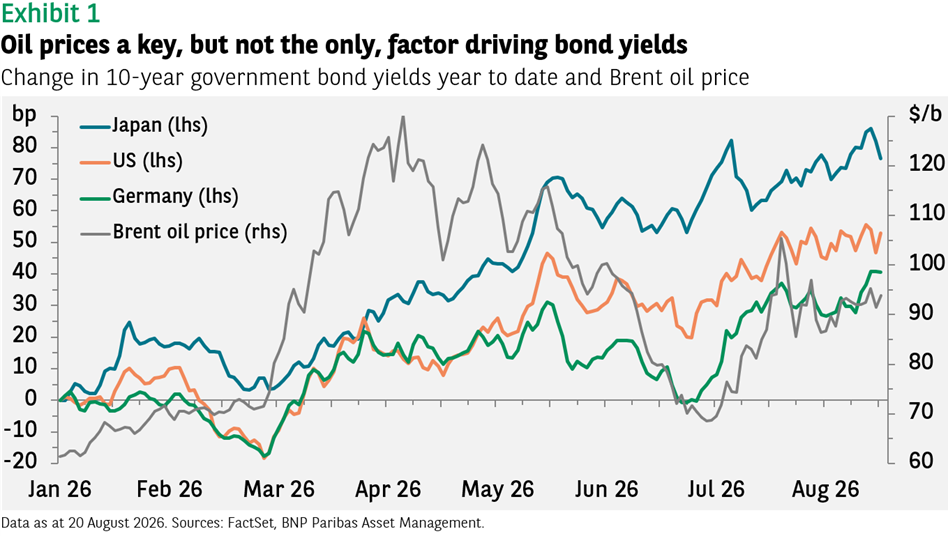
While oil prices are still elevated at over $90 per barrel, the marginal impact on inflation is fading. Pointing then to inflation as a driver of higher yields seems misplaced.
Indeed, the latest US CPI inflation was in line with forecasts and recent US economic data (retail sales and non-farm payrolls) was disappointing. As a result, forecasts for an increase in the fed funds rate by the end of the year have fallen. Inflation expectations are merely at an average level and have risen far less than Treasury yields since the end of June (see Exhibit 2).
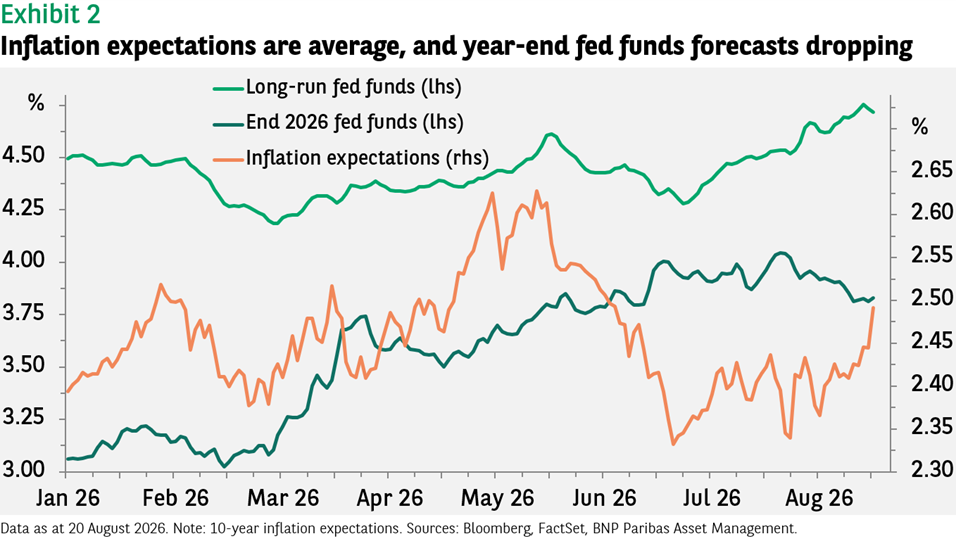
What has increased, however, is the market’s forecast for the long-run level of fed funds, which is at its highest since 2011. This increase can be the result of different factors. The impact of artificial intelligence is likely to be one of them. Not coincidentally, the rise in long-run fed funds began in early 2023, soon after the release of ChatGPT.
Whether AI will ultimately lead to higher or lower policy rates is still being debated by economists. One widely argued view is that AI will lead to an inflationary demand boom, requiring tighter monetary policy. Alternatively, a significant increase in productivity could allow rates to fall. The market would seem to be favouring the former explanation.
More recently, the change in leadership of the US Federal Reserve has increased uncertainty as the new Chair, Kevin Warsh, plans to communicate less on the Fed’s plans for monetary policy. The impact could be seen in US Treasury term premia, which have jumped over the last two months.
Debt sustainability
Concerns about the fiscal situation of most developed market governments are perennial, and understandably so. Debt levels have increased dramatically since the 2008 global financial crisis, and the end of quantitative easing means that governments are paying more to finance the debt.
Increasing budget deficits drive yields higher, and higher interest payments further increase budget deficits.
While the fiscal outlook is grim for many countries, it is not obvious that this has only just now become a concern for the markets. The US budget deficit increased to 6.9% in the second quarter according to Haver Analytics, but this is not particularly high by post-global financial crisis standards.
US government interest costs are rising, but at 16% of government expenditures it is below levels seen in the 1980s. Bloomberg data show US government debt credit default swap spreads falling.
Corporate credit issuance
A more plausible factor is the big increase in the amount of debt companies are raising. Corporate credit issuance reached $1.6 trillion by the end of July according to data from SIFMA (the US Securities Industry and Financial Markets Association), $225 billion (or 22%) more than at the same point in 2025.
Morningstar estimates that around $200 billion of this issuance is linked to hyperscalers.
For investors to absorb so much debt they will inevitably have to buy less of something else, pushing up yields. Given the high credit ratings of the ‘MAMA’ companies (Meta, Alphabet, Microsoft and Amazon, whose S&P ratings range from AA- to AAA for senior unsecured debt), the demand displacement could also impact US Treasuries (rated AA+).
Nonetheless, at the current pace total US debt issuance for the full year would be similar to the amount raised in 2020 and 2021.
The bottom line
A confluence of factors has conspired to push global bond yields higher: increased corporate bond issuance and higher term premia are more likely contributors than inflation or debt sustainability worries.
Were rates to rise further, what would the risk be to equity markets?
So far, the impact has been minimal. The MSCI All Country World IMI index (which includes small cap stocks) has gained 1.8% since the recent low in US yields on 29 June. There has been a clear divergence, however, in returns between indices that benefit from higher interest rates (generally value-oriented indices), and those that suffer (technology).
The US Russell Value index has gained 5.2%, followed by non-tech emerging market stocks only slightly less at 2.2% and MSCI Europe at 2.1%. Trailing these indices has been the tech sector, with the Nasdaq 100 down 1.9% and emerging market tech stocks off 11.1% (see Exhibit 3).
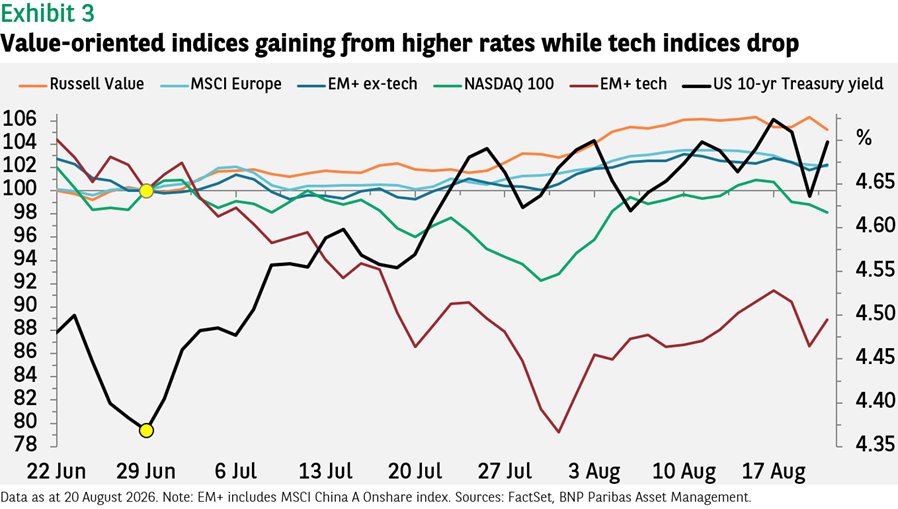
Higher interest rates are not the only factor behind the drop in tech stocks as the correction, particularly for Korean hardware and semiconductor names, had already begun earlier in June.
Nonetheless, higher rates can often lead to a drop in tech stocks thanks to the longer duration of their earnings, but once this has been priced in, they tend to recover quickly as superior earnings growth kicks in.
Corporate balance sheets are healthy and given the positive earnings outlook, most companies should be able to easily manage slightly higher financing costs.
Data sources: Bloomberg, FactSet, BNP Paribas Asset Management as of 20 August 2026 (unless otherwise stated). Past performance should not be seen as a guide to future returns.



Disclaimer
This document is for informational purposes only and does not constitute investment research or financial analysis relating to transactions in financial instruments as per MIF Directive (2014/65/EU), nor does it constitute on the part of BNP PARIBAS ASSET MANAGEMENT Europe or its affiliated companies an offer to buy or sell any investments, products or services, and should not be considered as solicitation or investment, legal or tax advice, a recommendation for an investment strategy or a personalized recommendation to buy or sell securities.
Due to its simplification, this document is partial and opinions, estimates and forecasts herein are subjective and subject to change without notice. There is no guarantee forecasts made will come to pass. Data, figures, declarations, analysis, predictions and other information in this document is provided based on our state of knowledge at the time of creation of this document. Whilst every care is taken, no representation or warranty (including liability towards third parties), express or implied, is made as to the accuracy, reliability or completeness of the information contained herein. Reliance upon information in this material is at the sole discretion of the recipient. This material does not contain sufficient information to support an investment decision.
Issued in the UK by AXA Investment Managers UK Limited, which is authorised and regulated by the Financial Conduct Authority in the UK. Registered in England and Wales, No: 01431068. Registered Office: 22 Bishopsgate, London, EC2N 4BQ.
AXA IM and BNPP AM are progressively merging and streamlining our legal entities to create a unified structure
AXA Investment Managers joined BNP Paribas Group in July 2025. Following the merger of AXA Investment Managers Paris and BNP PARIBAS ASSET MANAGEMENT Europe and their respective holding companies on December 31, 2025, the combined company now operates under the BNP PARIBAS ASSET MANAGEMENT Europe name.