



















Take Two: Bond sell-off endures; Eurozone inflation rises
What do you need to know?
Markets endured a volatile start to September as the global bond sell-off continued. Long-term government bond yields in the US, UK and Japan were among those to reach multi-year – and in some cases – multi-decade highs. The uncertainty came in the wake of an escalation of hostilities in the Middle East and concerns that central banks will have to raise interest rates to tackle inflation. In equity markets, over the week to Thursday’s close the MSCI World Index and S&P 500 were flat while Europe’s Stoxx 600 was 1% lower.*
*In US dollar terms. Source: FactSet, data as of 3 September 2026
Around the world
Eurozone annual inflation rose to 3.3% in August, up from 2.9% in July, according to an official flash estimate. The primary driver of the rise was energy costs, which rose by 14.3% on an annual basis, compared with 10.3% the month before. Notably core inflation, which excludes more volatile energy, food, alcohol and tobacco prices, eased to 2.4% in August, down from 2.5%. The latest data is likely to fortify the European Central Bank’s case for raising interest rates at its upcoming policy meeting this week.
Figure in focus: 1,286 gigawatts
Solar power has now overtaken coal for the first time as China's largest source of power generation. At the end of July, solar power capacity reached 1,286 gigawatts – some 31.5% of total power generation – compared to coal's 1,285 GW, according to reports citing official government data. Solar power output rose 15.5% in the first seven months of 2026, compared to the same period in 2025, and accounted for 13% of the country’s total electricity consumption. China is the world's largest emitter of greenhouse gases and has set a target of peak emissions by 2030 and achieving carbon neutrality by 2060.
Chart of the week
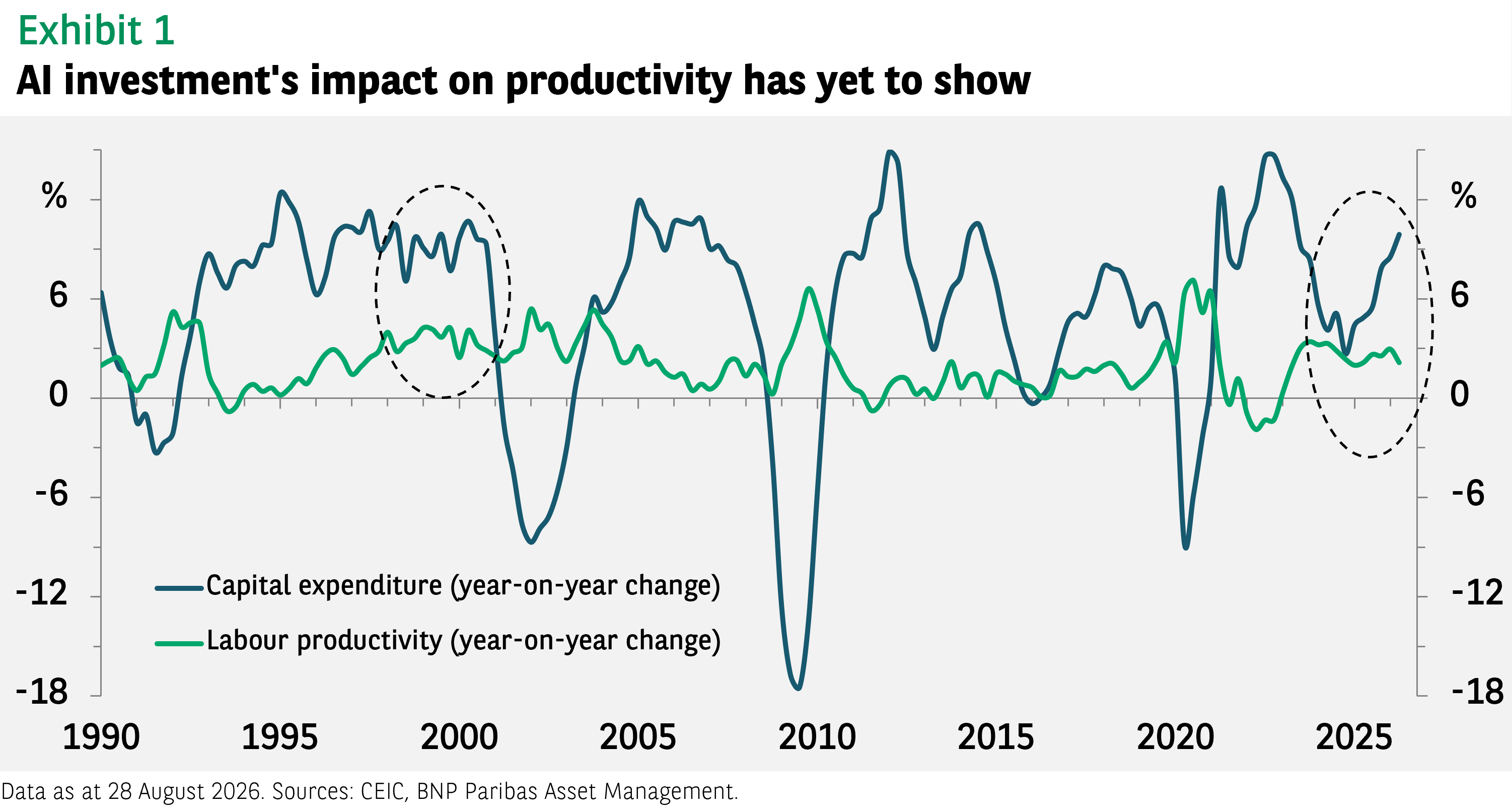
While some businesses may be seeing efficiency gains in specific functions because of artificial intelligence investment, those improvements have not yet translated into an increase in overall US productivity growth. Although AI capital expenditure is at a record high, national productivity growth is at 2.2%. Conversely, productivity growth in the dot-com era – around 1996-2000 – rose along with capex. For now, the reality is that technological breakthroughs can arrive quickly, but their benefits can take longer to show up, if at all.
Words of wisdom:
Innovation Ministerial: A two-day conference between G20 members that set out a new framework for unlocking the potential of emerging technologies. Hosted by the US in North Carolina, members adopted the Carolina Principles for Emerging Technologies, to promote innovation and enable the implementation of new technologies. G20 ministers also called for governments to take action to equip people with the skills to use emerging technologies, as well as to develop pro-innovation policy frameworks.
What’s coming up?
On Monday, the Eurozone reports its third estimate for second quarter GDP growth, while Japan follows with its final Q2 GDP data on Tuesday. Wednesday sees China publish its latest inflation data and on Thursday, the ECB convenes to set interest rates – at its last meeting it kept its key rates unchanged. Friday sees the UK issue July GDP numbers while the US reports inflation data.
Read more insights at the Investment Institute


Disclaimer
This document is for informational purposes only and does not constitute investment research or financial analysis relating to transactions in financial instruments as per MIF Directive (2014/65/EU), nor does it constitute on the part of BNP PARIBAS ASSET MANAGEMENT Europe or its affiliated companies an offer to buy or sell any investments, products or services, and should not be considered as solicitation or investment, legal or tax advice, a recommendation for an investment strategy or a personalized recommendation to buy or sell securities.
Due to its simplification, this document is partial and opinions, estimates and forecasts herein are subjective and subject to change without notice. There is no guarantee forecasts made will come to pass. Data, figures, declarations, analysis, predictions and other information in this document is provided based on our state of knowledge at the time of creation of this document. Whilst every care is taken, no representation or warranty (including liability towards third parties), express or implied, is made as to the accuracy, reliability or completeness of the information contained herein. Reliance upon information in this material is at the sole discretion of the recipient. This material does not contain sufficient information to support an investment decision.
Issued in the UK by AXA Investment Managers UK Limited, which is authorised and regulated by the Financial Conduct Authority in the UK. Registered in England and Wales, No: 01431068. Registered Office: 22 Bishopsgate, London, EC2N 4BQ.
AXA IM and BNPP AM are progressively merging and streamlining our legal entities to create a unified structure
AXA Investment Managers joined BNP Paribas Group in July 2025. Following the merger of AXA Investment Managers Paris and BNP PARIBAS ASSET MANAGEMENT Europe and their respective holding companies on December 31, 2025, the combined company now operates under the BNP PARIBAS ASSET MANAGEMENT Europe name.