



















Take Two: IMF lowers global growth forecast
What do you need to know?
The International Monetary Fund lowered its 2026 global economic growth forecast to 3%, from April’s 3.1% projection. The modest downgrade reflects the ongoing impact of the Middle East conflict and trade fragmentation but is partly offset by advances in artificial intelligence. However, the IMF expects growth to rebound to 3.4% in 2027. Meanwhile it also anticipates that global headline inflation will rise to 4.7% in 2026 - an increase from 4.1% in 2025 - before easing to 3.9% in 2027.
Around the world
Federal Reserve officials were split over the future direction of monetary policy but expect inflation to remain elevated in the near term, minutes of their first meeting under new Chair Kevin Warsh showed. They voted to leave interest rates on hold at 3.5%-3.75% in June, reflecting concerns over upside inflation risks. However, some policymakers felt the Fed funds rate should be within or slightly below the current target range at the end of this year, while others thought it should be higher. “Participants noted that their future policy actions would depend on incoming information,” the minutes said.
Figure in focus: 1%
China annual inflation rose more slowly than expected in June as elevated energy costs continued to weigh on domestic demand. The consumer price index rose 1%, below market expectations of 1.1% and easing from May’s 1.2%. Core inflation, excluding more volatile food and energy prices, also rose 1% and down from 1.1% the month before. Separately, the World Bank forecast China’s economy will slow to 4.4% growth in 2026 and 4.3% in 2027 from 5.0% in 2025 amid continued weakness in domestic demand, a new report showed.
Chart of the week
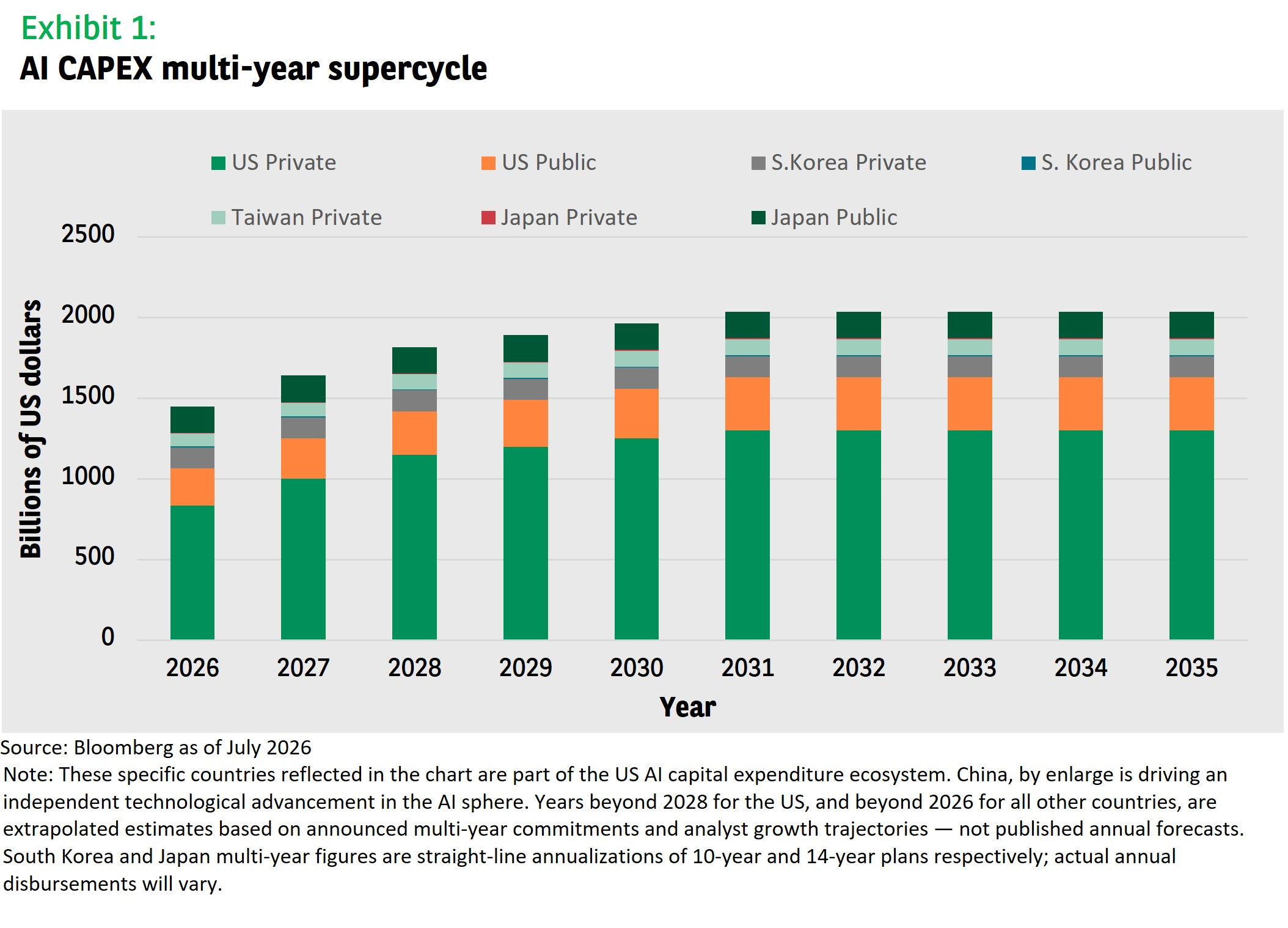
Artificial intelligence capital expenditure in 2026 reflects an unprecedented concentration of investment across the US, South Korea, Taiwan and Japan, with an approximately $835 billion commitment from the top US hyperscalers alone. This underscores a structural shift in how technology and industrial policy intersect – governments and corporations are no longer treating AI infrastructure as discretionary, but as a strategic imperative. Korean conglomerates – part of the AI supply chains – are scaling investments to match the increased demand for compute capacity. Japan’s current administration recently announced a 14-year investment plan including an estimated $600 billion of support for AI and semiconductors. Collectively, these and other commitments suggest AI infrastructure investment is entering a multi-year supercycle that is poised to fuel growth.
Words of wisdom
Neoscaler: Neoscalers are smaller, regionally focused cloud providers specialising in high-performance infrastructure for artificial intelligence model development. Unlike so called hyperscalers, which provide services to organisations needing large-scale data processing and storage, neoscalers provide AI developers with more tailored model training capabilities and infrastructure. Neoscalers could provide a new challenge to hyperscaler dominance across the AI stack, according to a new report from consultancy Alvarez & Marsal.
What’s coming up?
On Tuesday the US publishes a flash inflation estimate for June – its annual rate increased to 4.2% in May. Wednesday sees China issue second quarter GDP growth figures, while the Bank of Canada convenes to decide on interest rates. On Thursday, the UK publishes its GDP growth rate for May. On Friday the Eurozone publishes a final estimate of June’s inflation rate – the most recent data came in at 2.8% for June, down from May’s 3.2%.
Read more insights at the Investment Institute


Disclaimer
This document is for informational purposes only and does not constitute investment research or financial analysis relating to transactions in financial instruments as per MIF Directive (2014/65/EU), nor does it constitute on the part of BNP PARIBAS ASSET MANAGEMENT Europe or its affiliated companies an offer to buy or sell any investments, products or services, and should not be considered as solicitation or investment, legal or tax advice, a recommendation for an investment strategy or a personalized recommendation to buy or sell securities.
Due to its simplification, this document is partial and opinions, estimates and forecasts herein are subjective and subject to change without notice. There is no guarantee forecasts made will come to pass. Data, figures, declarations, analysis, predictions and other information in this document is provided based on our state of knowledge at the time of creation of this document. Whilst every care is taken, no representation or warranty (including liability towards third parties), express or implied, is made as to the accuracy, reliability or completeness of the information contained herein. Reliance upon information in this material is at the sole discretion of the recipient. This material does not contain sufficient information to support an investment decision.
Issued in the UK by AXA Investment Managers UK Limited, which is authorised and regulated by the Financial Conduct Authority in the UK. Registered in England and Wales, No: 01431068. Registered Office: 22 Bishopsgate, London, EC2N 4BQ.
AXA IM and BNPP AM are progressively merging and streamlining our legal entities to create a unified structure
AXA Investment Managers joined BNP Paribas Group in July 2025. Following the merger of AXA Investment Managers Paris and BNP PARIBAS ASSET MANAGEMENT Europe and their respective holding companies on December 31, 2025, the combined company now operates under the BNP PARIBAS ASSET MANAGEMENT Europe name.