



















Take Two: US inflation slows; Eurozone economy edges ahead in Q2
What do you need to know?
US annual inflation slowed for a second consecutive month to 3.4% in July, from 3.5% in June, in line with market expectations. Core inflation, which excludes more volatile food and energy prices, also eased, to 2.5% in July from 2.6%, matching its slowest pace since March 2021. The lower rate added to expectations that the Federal Reserve will keep interest rates unchanged when it meets next month. In July, the Fed kept rates on hold at 3.5%-3.75% by a 9-3 vote, noting that inflation remained above its 2% target.
Around the world
The eurozone’s economy grew by 0.4% in the second quarter, confirming a previous estimate, according to a Eurostat release. This compares to 0% growth in Q1. The release also showed that the number of people employed increased by 0.1% in the eurozone area over Q2, compared with the previous quarter. Compared with the same period in 2025, employment increased by 0.5%. Elsewhere, the UK economy grew 0.4% in Q2, in line with expectations but below Q1’s 0.6% expansion.
Figure in focus: $500 billion
Nvidia, the world's largest semiconductor company, announced partnerships with some of Wall Street's largest financial institutions in a bid to raise $500 billion in capital. The money will be used to finance artificial intelligence projects and infrastructure, including data centres and chip manufacturing facilities. It is expected to help enable AI companies meet demand where they do not have access to the financing themselves to build infrastructure quickly enough. Experts said the agreement represents a major shift in how AI infrastructure is funded.
Chart of the week
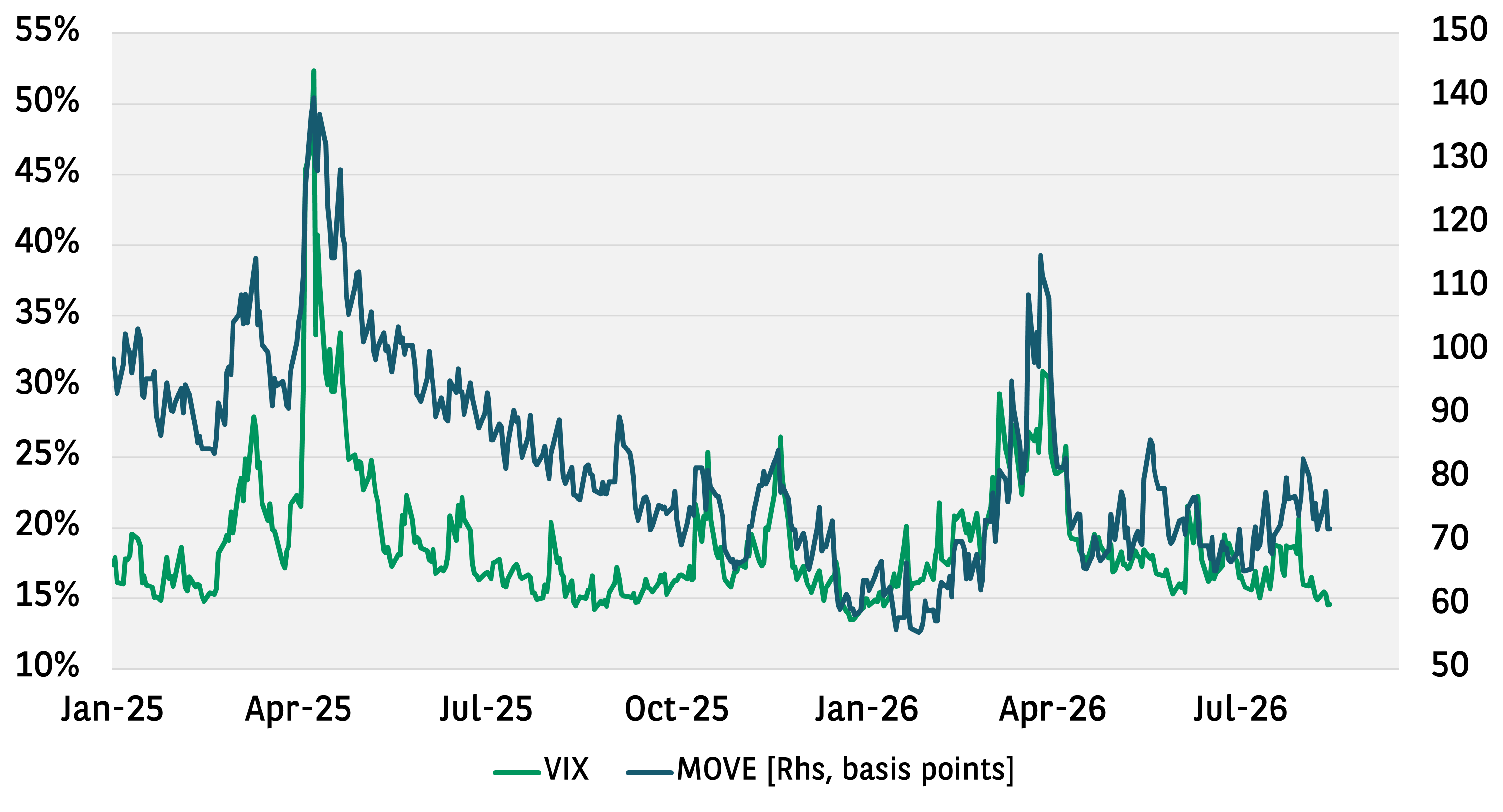
Presently stock markets do not seem to be too worried about a near-term correction. The volatility index, or VIX, is currently trading very close to this year’s lows, despite ongoing geopolitical tensions that generated a volatility spike only four months ago. Also, bond market turbulence has declined substantially from its peak at the end of March. However, a negative 10-year US Treasury performance in July, which saw yields climb above 4.70%, has probably unnerved investors to some degree, and bond market fluctuations have diverged from stock volatility.
Words of wisdom:
Big Mac Index: A light-hearted way of illustrating the theory of purchasing-power parity, comparing the price of a specific burger across different countries. The Big Mac Index, created by The Economist, celebrates its 40th anniversary this year, and aims to determine whether currencies are overvalued or undervalued in relation to the US dollar. The index indicates that Switzerland is currently the most expensive country to purchase a Big Mac, at approximately $9.00, while Indonesia the cheapest at around $2.40. However, critics have noted that average burger prices could be expected to be cheaper in countries with lower labour costs.
What’s coming up?
On Monday, Canada releases its latest inflation data, and Japan issues a preliminary estimate for Q2 economic growth. Wednesday sees the Federal Open Market Committee publish the minutes from its last rate setting meeting. The eurozone reports inflation data on Wednesday, followed by Japan on Friday. Friday also sees several flash Purchasing Managers’ Indices published, including those covering Japan, the eurozone, US and UK.
Read more insights at the Investment Institute


Disclaimer
This document is for informational purposes only and does not constitute investment research or financial analysis relating to transactions in financial instruments as per MIF Directive (2014/65/EU), nor does it constitute on the part of BNP PARIBAS ASSET MANAGEMENT Europe or its affiliated companies an offer to buy or sell any investments, products or services, and should not be considered as solicitation or investment, legal or tax advice, a recommendation for an investment strategy or a personalized recommendation to buy or sell securities.
Due to its simplification, this document is partial and opinions, estimates and forecasts herein are subjective and subject to change without notice. There is no guarantee forecasts made will come to pass. Data, figures, declarations, analysis, predictions and other information in this document is provided based on our state of knowledge at the time of creation of this document. Whilst every care is taken, no representation or warranty (including liability towards third parties), express or implied, is made as to the accuracy, reliability or completeness of the information contained herein. Reliance upon information in this material is at the sole discretion of the recipient. This material does not contain sufficient information to support an investment decision.
Issued in the UK by AXA Investment Managers UK Limited, which is authorised and regulated by the Financial Conduct Authority in the UK. Registered in England and Wales, No: 01431068. Registered Office: 22 Bishopsgate, London, EC2N 4BQ.
AXA IM and BNPP AM are progressively merging and streamlining our legal entities to create a unified structure
AXA Investment Managers joined BNP Paribas Group in July 2025. Following the merger of AXA Investment Managers Paris and BNP PARIBAS ASSET MANAGEMENT Europe and their respective holding companies on December 31, 2025, the combined company now operates under the BNP PARIBAS ASSET MANAGEMENT Europe name.
AXA IM and BNPP AM are progressively merging and streamlining our legal entities to create a unified structure
AXA Investment Managers joined BNP Paribas Group in July 2025. Following the merger of AXA Investment Managers Paris and BNP PARIBAS ASSET MANAGEMENT Europe and their respective holding companies on December 31, 2025, the combined company now operates under the BNP PARIBAS ASSET MANAGEMENT Europe name.
AXA IM and BNPP AM are progressively merging and streamlining our legal entities to create a unified structure
AXA Investment Managers joined BNP Paribas Group in July 2025. Following the merger of AXA Investment Managers Paris and BNP PARIBAS ASSET MANAGEMENT Europe and their respective holding companies on December 31, 2025, the combined company now operates under the BNP PARIBAS ASSET MANAGEMENT Europe name.