
















One Health through the lens of today’s investment megatrends
KEY POINTS
The forces shaping human health outcomes are far broader than hospitals, pharmaceuticals and medical devices.
Human health is dependent upon animal health and the health of the environment. Together the health of these three systems are inextricably intertwined, creating the One Health concept (Exhibit 1).
Exhibit 1: One Health defined
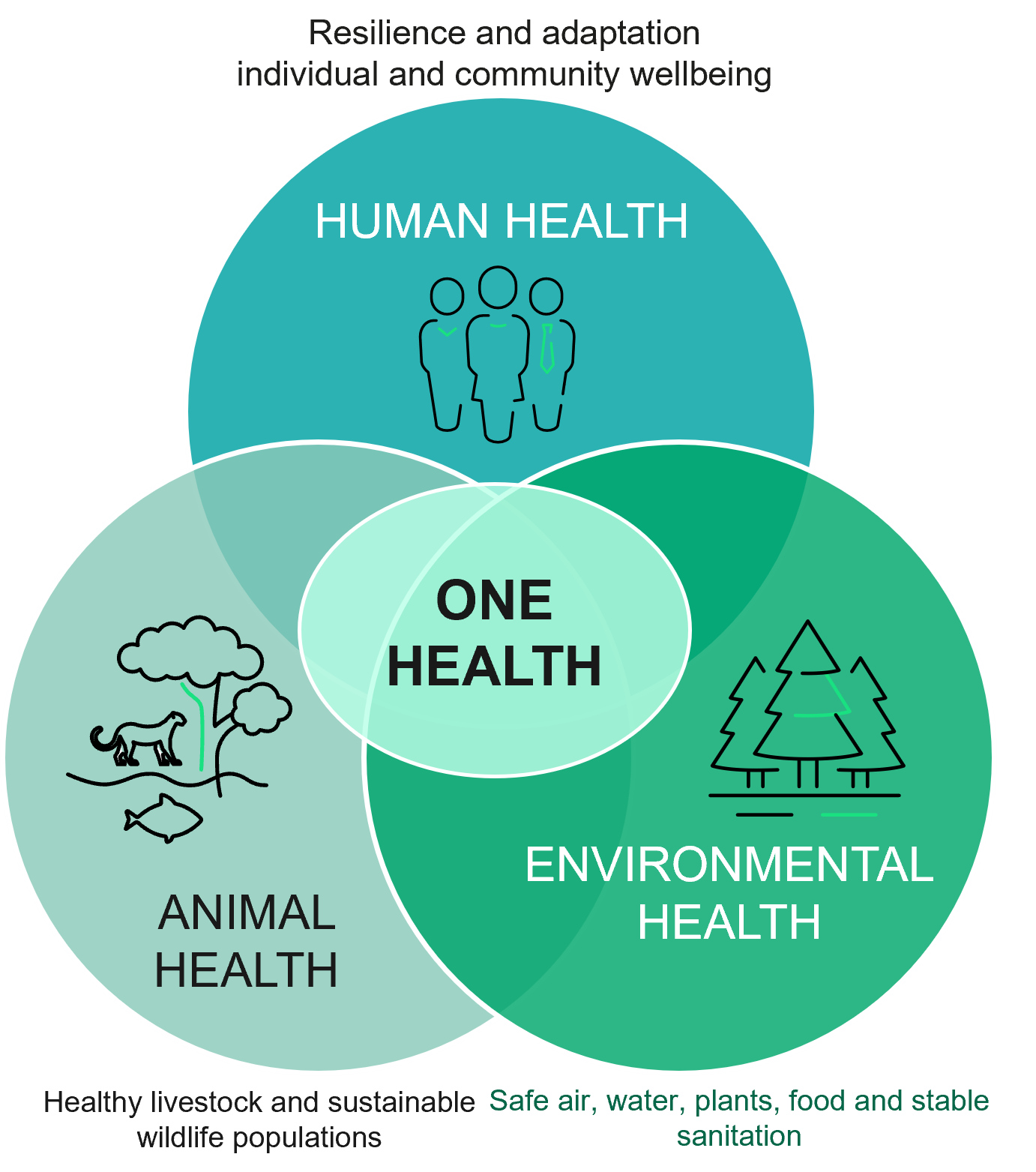
Source: What is One Health? | Center for One Health Research
For long-term investors, these health determinants are not peripheral; they shape and are shaped by productivity, labour participation, the resilience of communities and economies and other social systems.
While the pathways for One Health impacts are not always linear or clear, they can nevertheless be material to economic and financial outcomes for investors. Indeed, understanding how corporate investment can drive negative or create positive health outcomes for its stakeholders – employees, customers, communities, plants and animals – will be increasingly important in an increasingly interconnected world.
The One Health theme, grounded in preceding work by the World Health Organization and other supranationals, therefore gives us a useful frame for moving from a narrow sector view of health to a more systemic view of health-related value creation and risk.
It recognises that a workforce’s health can affect operating performance; that the health of consumers can influence the growth of markets; and that the health of ecosystems can determine the reliability of supply chains; the quality of natural inputs and the exposure of communities to disease.
Companies do not operate outside these systems. They depend on them and affect them.
This does not mean treating every social or environmental issue as a health issue. A disciplined One Health approach should improve, not dilute, investment analysis. The challenge is to identify where health determinants are financially material for a sector, issuer, or asset and through which transmission channels. To support related analysis BNPP AM’s megatrends provide a useful framework:
- Geopolitics: Global health outcomes depend on food security, access to medicines, resilient supply chains and international cooperation on health and environmental risks. Geopolitical fragmentation can increase vulnerabilities while cooperation can improve system resilience
- Environment: Human, animal and ecosystem health are deeply interconnected. Environmental pressures such as pollution, climate change, biodiversity loss and water stress affect public health, productivity and economic stability
- Demographics: Ageing populations, urbanisation and changing disease patterns are reshaping demand for healthcare, nutrition, housing and care services. Understanding demographic trends is essential to improving long-term health and economic resilience.
- Innovation: Breakthroughs in biotechnology, diagnostics, precision agriculture, data analytics and preventative care can improve health outcomes across interconnected human, animal and environmental systems. Innovation expands the range of investable health solutions
Geopolitics: Health security, resilience and strategic dependence
Access to healthcare and other social determinants of health – notably housing, food and water – is increasingly shaped by geopolitics. At the multinational level, restrictive trade policy, increased conflict, and decreased cooperation all serve to heighten the risk of future pandemics, worsening climate-related health impacts, and medicine or food shortages.
At the national level, shifts in the political landscape can result in declining quality of public services which can have cross-border effects. For instance, softening vaccine requirements could result in greater incidence of preventable disease.
Moreover, loss of public benefits like food or housing assistance can increase the public burden of disease which can have many knock-on effects for communities beyond the added frictional costs of increased emergency health treatments.
A One Health perspective shows that company resilience is dependent to a significant degree upon public institutions. This creates risks for companies dependent on vulnerable global supply chains, low-cost labour, or weakened public systems, but it also creates opportunities in healthcare security, diagnostics, and other solutions that support preparedness without simply shifting costs to consumers or governments.
Innovation: new solutions, new dependencies and new questions of access
Innovation is central to One Health because it changes what can be prevented, detected, treated and measured. Advances in medicines, environmental monitoring and AI-enabled discovery can improve health outcomes and strengthen resilience.
They can also help investors identify companies whose products and services reduce preventable harm while addressing structural demand. Healthcare innovation remains important, but the investable universe is broader than healthcare alone. It includes technologies and business models that improve the health of people, animals and ecosystems together.
At the same time, innovation can create new dependencies and unintended consequences. Digital health tools may improve access but raise questions about privacy, exclusion and quality of care.
Artificial intelligence can accelerate drug discovery, diagnostics and environmental monitoring, but it can also increase energy and water demand and concentrate benefits among firms with data, compute and distribution advantages.
Agricultural technology can reduce chemical and antibiotic use, but it can also deepen dependence on proprietary inputs. The investment question is therefore not whether innovation is positive in general, but whether the business model, governance, affordability, lifecycle impacts and measurable outcomes support durable value creation.
A One Health lens helps distinguish innovation that genuinely improves resilience from innovation that merely increases efficiency while shifting health or environmental costs elsewhere.
Demographics: Demand, vulnerability and health’s social determinants
Demographics are reshaping One Health considerations with different trends driving different outcomes. Ageing populations, particularly in developed markets, create significant risks if the transition is unmanaged.
But well managed, it can create huge opportunities for investments in the care economy including long-term care, mobility solutions and age-friendly housing.1
Urbanisation, particularly pronounced in emerging markets, increases the importance of sanitation, air quality, housing quality, green space, transport design and heat resilience.
Migration and regional demographic divergence influence labour availability, fiscal capacity and the vulnerability of communities to public health and climate shocks. Labour market participation and socioeconomic inequality can create political risk and shift aggregate demand patterns.
- {https://www3.weforum.org/docs/WEF_The_Future_of_the_Care_Economy_2024.pdf}
Environment: Ecosystems as health infrastructure
Environment is perhaps the most intuitive One Health lens because air quality and ecosystem health are a foundation for human and animal health. Climate change, biodiversity loss, and water availability all influence exposure to disease, heat stress and unsafe living conditions.
An estimated nine million premature deaths each year are caused by pollution and 90% of the global population is exposed to ambient concentrations of fine particulate matter (PM2.5) above the WHO annual air quality guideline.2 Additionally, over 60% of emerging infectious diseases originate in animals.3
Perhaps one of the most trenchant examples of the human health and animal health connection is antimicrobial resistance. It arises when bacteria, viruses, fungi, and parasites evolve to resist the medications that once effectively treated infections.
And its rise in humans can largely be traced to the overuse of antibiotics in livestock. Understanding the societal ramifications of consumer preferences for meat and business preferences for efficient solutions to problems (in this case, animals often living in close-quarters getting sick) is supported by a One Health perspective.
- {https://www.unep.org/en/publications/report/global-environment-outlook-7}
- {https://pmc.ncbi.nlm.nih.gov/articles/PMC10043475/}
Why investors should care
Within BNPP AM’s Global Sustainability Strategy, One Health therefore sits alongside Transition and Sustainable AI as part of our forward-looking research agenda. One Health matters for investors because it connects health outcomes to the systems that sustain long-term economic value.
It broadens the investment lens from healthcare spending to the determinants of health that for example shape worker productivity/availability and supply-chain reliability. It also helps identify risks that markets may underprice because they sit between sectors, time horizons or asset classes.
Antimicrobial resistance, unsafe food systems, pollution exposure, heat stress, biodiversity loss, weak health access and social isolation may each appear narrow at first, but together they can affect corporate earnings, sovereign credit, labour markets and long-term market performance.
The investor implications are practical. First, One Health supports better risk identification by linking health determinants to financially material transmission channels such as input costs, workforce productivity and tail risks.
Second, it supports opportunity identification by clarifying where durable demand may emerge for prevention-oriented healthcare, affordable housing, climate adaptation and nature-based solutions.
And third, it supports stewardship by helping investors ask whether companies are reducing preventable harm, strengthening resilience and measuring outcomes, rather than relying on broad claims.
Measurement will be central. One Health is powerful because it captures interdependence, but that also makes it vulnerable to over-claiming. Investors need fit-for-purpose indicators that distinguish inputs, outputs and outcomes; recognise time horizons; and avoid overstating causality. We will continue our work on this over the years to come.


Disclaimer
This document is for informational purposes only and does not constitute investment research or financial analysis relating to transactions in financial instruments as per MIF Directive (2014/65/EU), nor does it constitute on the part of BNP PARIBAS ASSET MANAGEMENT Europe or its affiliated companies an offer to buy or sell any investments, products or services, and should not be considered as solicitation or investment, legal or tax advice, a recommendation for an investment strategy or a personalized recommendation to buy or sell securities.
Due to its simplification, this document is partial and opinions, estimates and forecasts herein are subjective and subject to change without notice. There is no guarantee forecasts made will come to pass. Data, figures, declarations, analysis, predictions and other information in this document is provided based on our state of knowledge at the time of creation of this document. Whilst every care is taken, no representation or warranty (including liability towards third parties), express or implied, is made as to the accuracy, reliability or completeness of the information contained herein. Reliance upon information in this material is at the sole discretion of the recipient. This material does not contain sufficient information to support an investment decision.
Issued in the UK by AXA Investment Managers UK Limited, which is authorised and regulated by the Financial Conduct Authority in the UK. Registered in England and Wales, No: 01431068. Registered Office: 22 Bishopsgate, London, EC2N 4BQ.
AXA IM and BNPP AM are progressively merging and streamlining our legal entities to create a unified structure
AXA Investment Managers joined BNP Paribas Group in July 2025. Following the merger of AXA Investment Managers Paris and BNP PARIBAS ASSET MANAGEMENT Europe and their respective holding companies on December 31, 2025, the combined company now operates under the BNP PARIBAS ASSET MANAGEMENT Europe name.