



















The rise of decommissioning bonds in transition finance
KEY POINTS
Transition finance is any capital that supports high-emitting, carbon-intensive entities or activities to shift toward net-zero alignment.
Unlike 'green finance’ which primarily funds already low-carbon assets like solar farms, wind power, or electric vehicles, transition finance targets high-carbon or hard-to-abate sectors, such as thermal power generation, steel, cement, mining, oil and gas.
It provides the financial bridge necessary to decarbonise operations, adopt alternative technologies, or systematically wind down carbon-heavy infrastructure.
Transition bonds are therefore a stand-alone bond category distinct from green, social, sustainable (GSS) or sustainability-linked bonds1. The International Capital Market Association’s Climate Transition Bond Guidelines has a non-exhaustive list of eligible project categories.
One of these categories is the retirement and decommissioning of high-emission assets, including the permanent early retirement of coal-fired power plants.2
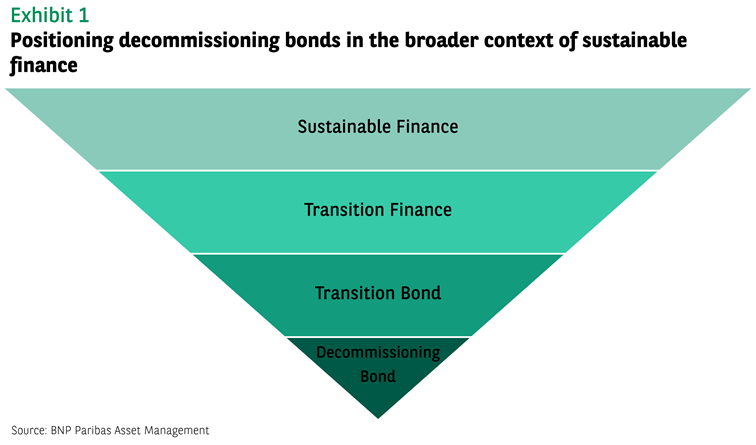
Within the transition finance architecture, decommissioning finance forms a specialised subset, which focuses specifically on the final stage of an asset’s life cycle: the physical retirement, dismantling, safe closure, environmental remediation, and asset / land repurposing of carbon-intensive or environmentally hazardous infrastructure.
While broader transition finance may fund capital expenditure to lower operational carbon intensity (e.g. adding carbon capture to a steel mill), decommissioning finance addresses the capitalrequirements associated with ending high emissions activities entirely while restoring the surrounding ecological and social fabric.
There are various decommissioning financing structures as well as several challenges around labelled decommissioning funding. We outline these below.
- {https://viewpoint.bnpparibas-am.com/green-is-not-enough-the-need-to-scale-up-transition-finance/}
- {https://www.icmagroup.org/assets/documents/Sustainable-finance/2025-updates/Climate-Transition-Bond-Guidelines-CTBG-November-2025.pdf}
Decommissioning financing structures and historical precedents
Historically, bonds dedicated to fund decommissioning obligations were issued as conventional debt, and managed through balance sheet provisions, or kept off balance sheets. Such bonds were rarely (if ever) accompanied by environmental, social or governance commitments / targets or related reporting.
In the case of a general obligation decommissioning bond structure, the debt is traditionally backed by the issuer’s creditworthiness and ongoing commercial revenue streams, rather than revenue generated by the decommissioning process itself.
The bondholders face general corporate credit risk, while the funds are earmarked to offset long-term asset retirement obligations.
The possibility for firms in industries such as fossil fuel exploration and production or power generation to tap sustainable bond markets to finance decommissioning activities is relatively novel. But equally it represents an opportunity for investors to support a low-carbon and just transition – as in our view decommissioning bonds offer:
- Better visibility over use of capital: A defined use-of-proceeds framework can allow investors to trace financing to closure, remediation, reserve funding and repurposing rather than to unrestricted corporate expenditure
- Potential reduction in long-term issuer risk: Successful prefunding may reduce future liquidity shocks, capital calls and dependence on commodity-cycle cash flows. Markets may reward companies that proactively fund and transparently manage decommissioning, while unfunded companies may face higher risk premia - this is a potential credit benefit, not an automatic result3
- Transition and real-world impact: Investors may finance the permanent retirement of high-emitting assets, remediation, methane-risk reduction, biodiversity restoration, recycling, workforce support and site repurposing. These potential positive outcomes need to be connected to investors’ impact objectives
- Engagement and stewardship: Investors can differentiate issuers according to funding quality, press for prefunding and insurance, assess decommissioning liabilities as debt-like exposures, and monitor policy and disclosure. A bond framework can create contractual reporting points around which this engagement can be organised
Relative-value opportunities: There is an emerging distinction between well-funded, financially flexible companies and structurally constrained companies. Investors may potentially use funding quality, reserve coverage, transition credibility and liability disclosure as additional dimensions of credit selection
Different Decommissioning Financing Mechanisms
Area Focus Funds / cash reserves Operators set aside a portion of annual revenues into liquid reserves or cash over the operating life of the assets. Dedicated trust funds Companies transfer cash into segregated oil and gas funds or state-monitored nuclear waste funds which can be used for management and remediation of the related assets. Pay as you go approach: Issuers fund decommissioning liabilities out of their general corporate treasury, relying on overall balance sheet cash generation rather than setting aside dedicated funds Transition bond issuance Transition bonds can be earmarked for decommissioning projects, which demonstrably contribute to transitioning to a green, social or sustainable future Guarantees Financial guarantees provided by parent entities or third-party insurers help meet post-closure liabilities
- See Global Decommissioning Liabilities: Financial Risks and Strategic Implications, BNP Paribas Asset Management, September 2026.
Transition bonds: A new pathway for funding decommissioning:
Emerging frameworks for decommissioning bonds elevate these instruments beyond routine remediation.
Instead of merely paying for toxic cleanup, the use-of-proceeds or target performance metrics are designed to achieve dual environmental and social outcomes with strong governance oversight.
Some of the criteria to be assessed when underwriting a decommissioning bond as a transition finance vehicle follow:
| Key ESG Areas | Key ESG Focuses |
| Environmental |
|
| Social |
|
| Governance |
|
Opportunities for labelled decommissioning bonds should be expected to increase with the potential advent of a Transition fund category in SFDR 2.0 (aka Article 7) and with the ongoing evolution of ICMA and other voluntary transition bond frameworks.
Risks and opportunities through investors’ potential mechanics
Decommissioning finance is shifting from a general balance sheet liability into a strategically structured transition financing opportunity.
With the evolution of transition financing frameworks and SFDR 2.0, issuers may be able to attract specialised capital while mitigating risks and costs associated with long-term asset retirement obligations.
While decommissioning can be financed in many ways, for investors, the potential increase in general obligation funding with use of proceeds tied to decommissioning projects is likely to be of interest.
However, underwriting these issuances will require careful due diligence to ensure that the related decommissioning strategy supports institutions and sectors’ broader transition goals.


Disclaimer
This document is for informational purposes only and does not constitute investment research or financial analysis relating to transactions in financial instruments as per MIF Directive (2014/65/EU), nor does it constitute on the part of BNP PARIBAS ASSET MANAGEMENT Europe or its affiliated companies an offer to buy or sell any investments, products or services, and should not be considered as solicitation or investment, legal or tax advice, a recommendation for an investment strategy or a personalized recommendation to buy or sell securities.
Due to its simplification, this document is partial and opinions, estimates and forecasts herein are subjective and subject to change without notice. There is no guarantee forecasts made will come to pass. Data, figures, declarations, analysis, predictions and other information in this document is provided based on our state of knowledge at the time of creation of this document. Whilst every care is taken, no representation or warranty (including liability towards third parties), express or implied, is made as to the accuracy, reliability or completeness of the information contained herein. Reliance upon information in this material is at the sole discretion of the recipient. This material does not contain sufficient information to support an investment decision.
Issued in the UK by AXA Investment Managers UK Limited, which is authorised and regulated by the Financial Conduct Authority in the UK. Registered in England and Wales, No: 01431068. Registered Office: 22 Bishopsgate, London, EC2N 4BQ.
AXA IM and BNPP AM are progressively merging and streamlining our legal entities to create a unified structure
AXA Investment Managers joined BNP Paribas Group in July 2025. Following the merger of AXA Investment Managers Paris and BNP PARIBAS ASSET MANAGEMENT Europe and their respective holding companies on December 31, 2025, the combined company now operates under the BNP PARIBAS ASSET MANAGEMENT Europe name.