



















Why have emerging market tech stocks been so volatile?
Away from European bond markets, the major story for equity markets has been renewed volatility in emerging market (EM) semiconductor and technology hardware stocks. An index of these companies has dropped back towards the lows of late July, though they are still 1.8% above that level. This leaves them 28% below the July peak but with a year-to-date gain of 47%.
While the declines from the highs are unfortunate, this level of volatility should not be surprising. Estimates of the impact of the artificial intelligence phenomenon on the economy and on corporate profits range widely. This can be seen in the rising standard deviation of estimates for EM tech hardware stocks, which has jumped from 10 at the beginning of the year to 82 today. By contrast, the variation for non-tech stocks has stayed constant at around five (see Exhibit 1).
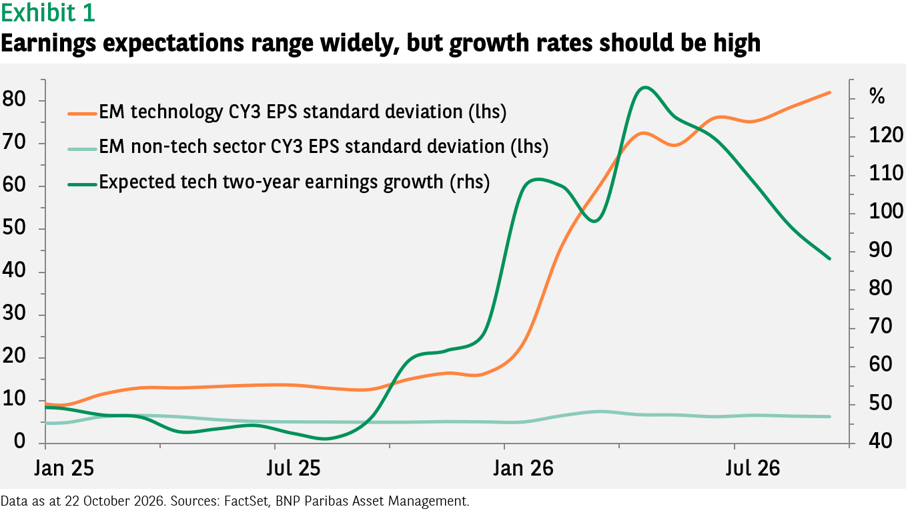
The consequence of the current high degree of uncertainty is that any marginal information can lead to a big change in the forecast for corporate profits, which can then lead to a big change in the stock price.
The key factor for investors with a longer-term time horizon is that the earnings growth in the years ahead should nonetheless be significantly positive; current forecasts for the next two years are near 90%. If in the end it turns out to be some (modest) percentage greater or less than those forecasts is secondary.


Disclaimer
This document is for informational purposes only and does not constitute investment research or financial analysis relating to transactions in financial instruments as per MIF Directive (2014/65/EU), nor does it constitute on the part of BNP PARIBAS ASSET MANAGEMENT Europe or its affiliated companies an offer to buy or sell any investments, products or services, and should not be considered as solicitation or investment, legal or tax advice, a recommendation for an investment strategy or a personalized recommendation to buy or sell securities.
Due to its simplification, this document is partial and opinions, estimates and forecasts herein are subjective and subject to change without notice. There is no guarantee forecasts made will come to pass. Data, figures, declarations, analysis, predictions and other information in this document is provided based on our state of knowledge at the time of creation of this document. Whilst every care is taken, no representation or warranty (including liability towards third parties), express or implied, is made as to the accuracy, reliability or completeness of the information contained herein. Reliance upon information in this material is at the sole discretion of the recipient. This material does not contain sufficient information to support an investment decision.
Issued in the UK by AXA Investment Managers UK Limited, which is authorised and regulated by the Financial Conduct Authority in the UK. Registered in England and Wales, No: 01431068. Registered Office: 22 Bishopsgate, London, EC2N 4BQ.
AXA IM and BNPP AM are progressively merging and streamlining our legal entities to create a unified structure
AXA Investment Managers joined BNP Paribas Group in July 2025. Following the merger of AXA Investment Managers Paris and BNP PARIBAS ASSET MANAGEMENT Europe and their respective holding companies on December 31, 2025, the combined company now operates under the BNP PARIBAS ASSET MANAGEMENT Europe name.